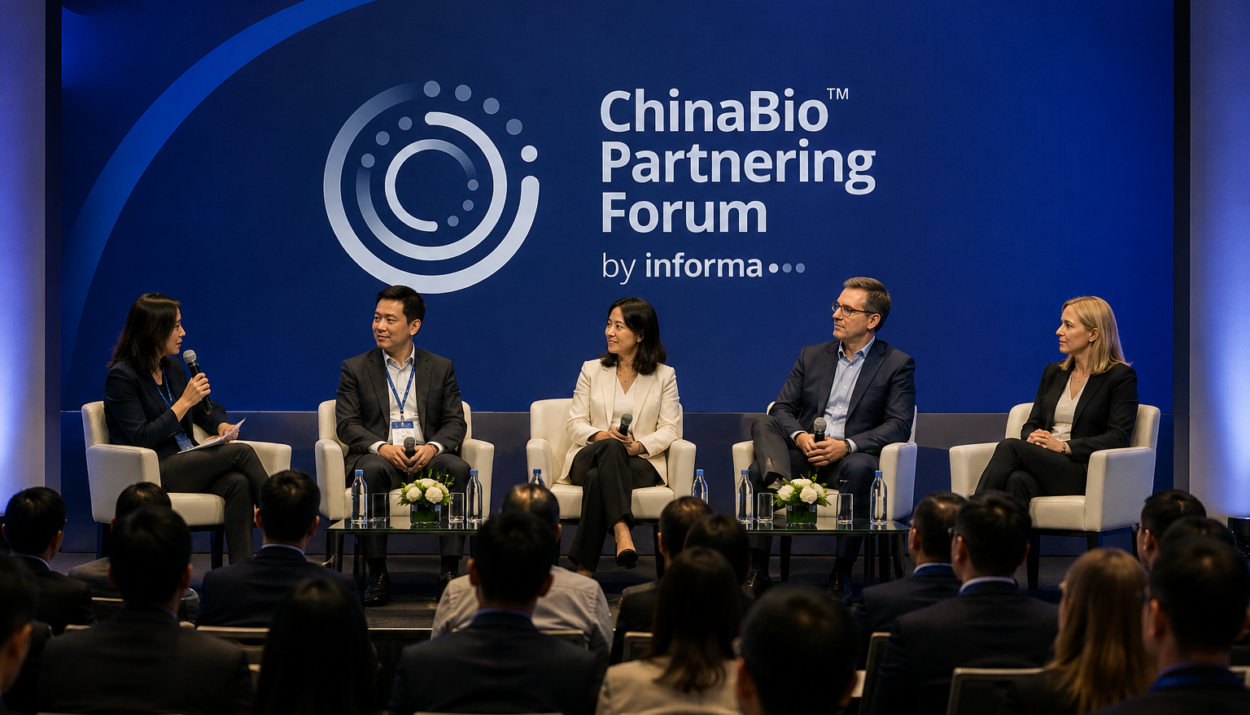

Deal flow out of China is accelerating fast. Cross-border licensing values from Chinese biotechs reached close to $1 billion in announced deals last year — double 2024 figures, which were themselves double those of 2023. At China BIO 2026, a panel moderated by Helen Chen, Global Sector Co-Head for Healthcare & Life Sciences at L.E.K. Consulting, brought together Marya Postner of Cooley, Celine Bouquet of Roche, Linda Zhao of MSQ Ventures, Dianna Qian of Cathay Capital, and Peng Xu of Lundbeck China to examine what this surge means for how Chinese biotechs should grow.
The Integration Question
Building a fully integrated biopharma — from R&D through commercial — was the ambition of the last boom cycle. That model is now under pressure. An L.E.K. survey from late last year found roughly 80% of Chinese biotechs conducting international trials were doing so to attract a co-development or co-commercialization partner. Only about 25% were pursuing independent commercialization.
The cost math is stark. The Roche representative put phase three trial costs at $100–500 million per program, with launch costs in the same range. Building and sustaining that infrastructure requires a pipeline deep enough to keep it running — something few Chinese biotechs currently have.

One cautionary case came from MSQ Ventures. Its managing director previously led US business development for Hengrui, which in 2020 established a US subsidiary called Luzsana to independently develop and commercialize 11 programs ex-China. That effort was eventually wound down. Key lessons cited: the multi-billion-dollar cost of full commercial operations, cultural gaps between China headquarters and overseas subsidiaries, and the efficiency advantages of China-based R&D that make replication abroad costly.
When and How to Partner
Proof-of-concept remains the traditional trigger for licensing deals. The Cathay Capital representative noted that deal timing is shifting earlier, driven by two forces: multinationals accelerating asset acquisition ahead of patent cliffs, and biotechs needing capital after two lean funding years.
For platform companies, the calculus is different. The Cooley representative argued that platform technology has a half-life — typically five to ten years — and that taking every asset to POC individually wastes the breadth of the platform. Partnering earlier across multiple programs creates more shots on goal than a single-asset, wait-and-see approach.

The Roche representative offered a structural view: partnering should not be a binary or last-resort decision. It should be embedded in company strategy from formation. Early-stage conversations with large pharma are, in her words, essentially free consulting — they clarify development pathways, identify key experiments, and can span years before a deal is signed. More than half of Roche’s clinical pipeline and 60% of its sales come from externally partnered assets, making inbound dialogue a standing priority.
The Lundbeck representative added a CNS-specific angle. In neuroscience, running a clinical program requires disease-specific site networks, biomarker infrastructure, and therapeutic expertise that most biotechs lack. The value of a CNS partner goes beyond capital. Lundbeck recently partnered with RNA-focused company Argenta before venture capital entered — illustrating that deep domain expertise can justify earlier-than-typical deal timing.
Are Chinese Assets Still Undervalued?
An audience question from Dr. Reddy’s raised whether rising deal values are making Chinese assets too expensive. Panelists were direct: they are not.
The MSQ Ventures representative noted that Western buyers initially came to China seeking discounted assets, partly due to skepticism around Chinese clinical data. That discount has now closed. The Cathay Capital representative estimated Chinese asset pricing has risen from roughly one-third of comparable Western valuations two to three years ago to approximate parity today.
The Roche representative said geography plays no role in how Roche prices deals — asset quality and differentiation are the only variables. The Cooley representative observed that even identical assets are valued differently by different buyers, depending on pipeline gaps and strategic fit. Valuation, she noted, is rarely purely objective.
The Lundbeck representative pointed to Hong Kong versus Nasdaq IPO valuations as supporting evidence that Chinese biotech is being priced competitively across capital markets. The quality of innovation — particularly in neuroscience — is the underlying driver.
What Comes Next
Panelists converged on a few forward-looking principles. Cash remains critical — the investor representatives advised taking attractive deal terms when available, unless the asset in question is the company’s sole path to IPO or the remaining pipeline lacks depth. Having alternatives on the table before entering deal negotiations was cited as the single biggest lever for improving terms.
The broader trend favors a “build to partner” model rather than full integration or pure licensing. Chinese biotechs are increasingly expected to advance assets to meaningful clinical milestones, then bring in partners with the infrastructure, disease expertise, and commercial reach to take programs the rest of the way.
Cross-border licensing out of China is unlikely to plateau soon. As Chinese R&D efficiency continues to outpace Western benchmarks on cost and speed, demand from multinationals facing loss of exclusivity will sustain deal flow — potentially accelerating it further as CNS joins oncology and immunology as a recognized source of Chinese innovation.

Moe Alsumidaie is Chief Editor of The Clinical Trial Vanguard. Moe holds decades of experience in the clinical trials industry. Moe also serves as Head of Research at CliniBiz and Chief Data Scientist at Annex Clinical Corporation.