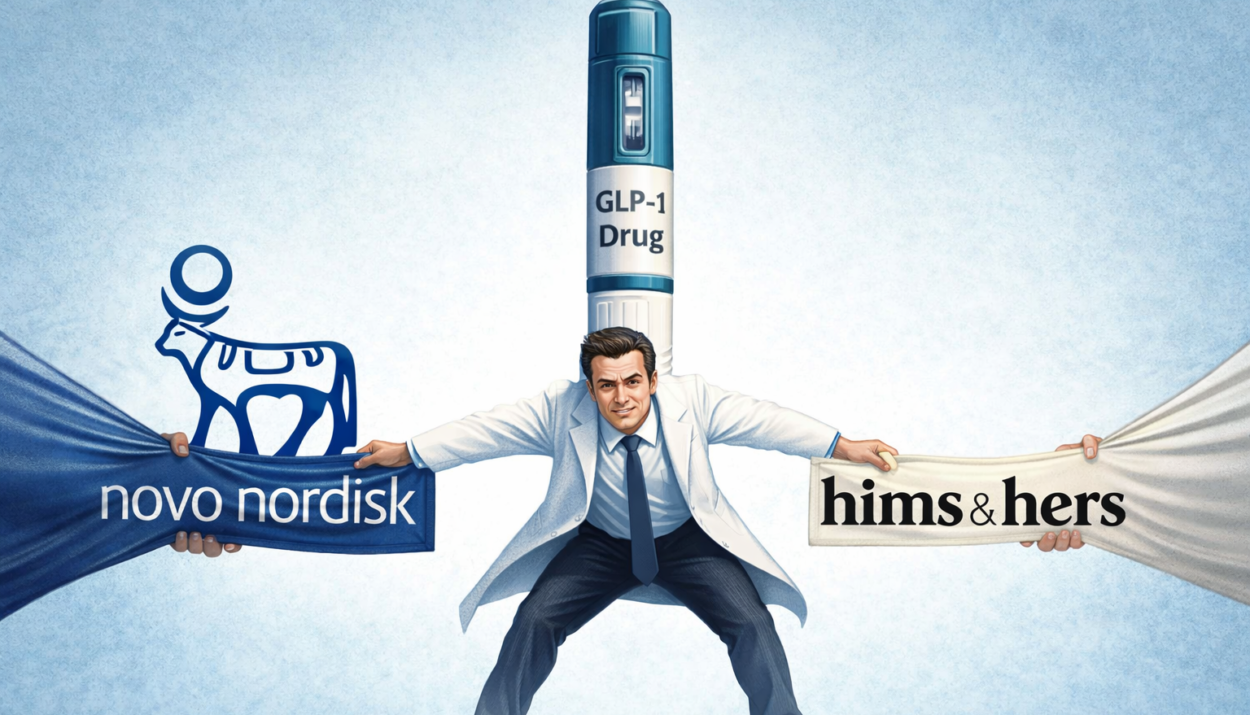

Hims & Hers stock surged 57% in a single week after announcing a commercial partnership with Novo Nordisk, its best weekly performance ever. The market read it as validation — a scrappy telehealth platform finally earning its seat at the adult table of branded pharma. Novo’s investors shrugged, treating it as a low-risk distribution experiment for a drug already generating nearly $37.8 billion in 2024 revenue.
Both readings miss the point entirely.
What Novo Nordisk actually did was legitimize a channel that spent the better part of 2023 and 2024 undercutting its flagship asset. Compounding pharmacies and telehealth platforms — the ecosystem Hims & Hers sits at the center of — were the primary reason the FDA’s shortage designation for semaglutide became a commercial battlefield, not just a supply chain problem. Hims & Hers was selling compounded semaglutide to 100,000 incremental subscribers at a fraction of Wegovy’s $1,349 list price. Novo’s legal and commercial teams spent months pushing back. Now they’re writing the partnership announcement together.
The Pricing Floor Nobody Is Defending
Here is the counterintuitive read: Novo Nordisk’s biggest GLP-1 risk in 2026 is no longer Eli Lilly’s tirzepatide. It’s the reference price that this deal just anchored in the American consumer’s mind.

Wegovy’s commercial model depends on a specific fiction — that $1,350 per month is the list price for semaglutide, and that the only meaningful path to affordability runs through Novo’s own savings card program or employer formulary coverage. That fiction was already under pressure. The FDA’s February 2025 determination that the semaglutide shortage had ended restricted the general compounding of semaglutide, and following a legal dispute with Novo Nordisk, platforms like Hims & Hers have since agreed to stop advertising compounded GLP-1 products and offer branded alternatives. Instead, Novo Nordisk has now partnered with Hims & Hers to offer branded semaglutide products at self-pay prices comparable to other digital health platforms. The distance between these comparable self-pay prices and $1,350 is not a discount. It is a confession that the list price was never defensible on its own.
Eli Lilly’s team is watching this with something close to professional satisfaction. Lilly has been more aggressive about defending Zepbound’s pricing integrity, resisting pressure to create compounding-adjacent channels while simultaneously building out its own direct-to-consumer LillyDirect platform — a pharmacy experience Lilly controls end-to-end, at list price, with proprietary savings architecture. Lilly’s Q4 2024 earnings call highlighted that managing realized prices and product mix was crucial for its gross margin. Novo just complicated its own version of that argument.
What This Deal Reveals About the Obesity Market’s Structural Fault Line
The GLP-1 market is bifurcating faster than most commercial forecasts anticipated, and the Hims & Hers deal is the clearest evidence yet of where the fault line runs. On one side: vertically integrated manufacturers who control their own dispensing, pricing, and patient engagement. On the other: branded pharma companies that need retail and specialty pharmacy scale but are increasingly finding that scale comes with a channel conflict tax.
Hims & Hers reported 2.2 million subscribers as of its most recent earnings, with a significant portion having demonstrated willingness to pay out-of-pocket for GLP-1 medications. That’s a commercially validated, payer-agnostic patient population — the kind of consumer segment that health economists call “price-revealed preference.” These patients already told the market they would pay cash. Following a recent partnership between Hims & Hers and Novo Nordisk, Hims & Hers will now offer branded Novo Nordisk GLP-1 products, while largely ceasing to promote compounded alternatives. This positions Novo Nordisk to reach these cash-pay patients, while still facing competition from Lilly or the next wave of oral GLP-1 entrants, where Roche’s CT-388 is advancing into Phase 3 development.

The oral GLP-1 timeline matters here. Once a once-daily oral option reaches commercial scale — for example, other oral GLP-1 programs are advancing through Phase 3 trials — the entire justification for injectable premium pricing collapses further. Novo’s window to monetize the injectable semaglutide franchise at anything close to current list pricing is probably three to four years. The Hims & Hers deal reads less like a growth strategy and more like an accelerated harvesting play — grab the cash-pay patients now, before oral bioavailability makes the delivery mechanism irrelevant.
The Boardroom Calculus No One Is Writing Down
For Novo’s BD and commercial leadership, the honest internal debate is probably not about Hims & Hers at all. It’s about what this deal signals to hospital systems, PBMs, and employer plan sponsors who have been negotiating semaglutide rebates in good faith against a list price of approximately $1,349 per month for Wegovy. Novo Nordisk has announced plans to cut the U.S. wholesale acquisition cost (WAC) of its semaglutide products to $675 per month, effective January 1, 2027, a 50% reduction for Wegovy. If a cash-pay patient on a telehealth platform can access branded semaglutide for as low as $149 per month for the starting dose of the Wegovy pill or $199 per month for introductory doses of injectable Wegovy, the question every CVS Health pharmacy benefits team and every Fortune 500 HR director will ask by Q3 2026 is why their negotiated net price is still north of $800 after rebates. That conversation reshapes the entire Wegovy contracting cycle.
Biotech executives watching from the obesity pipeline — particularly companies like Viking Therapeutics, which initiated Phase 3 trials for its subcutaneous VK2735 program around mid-2025 and is planning to initiate two Phase 3 trials for its oral program in Q3 2026, and Structure Therapeutics with its oral GPCR platform — should be accelerating their own commercial architecture decisions right now. The Hims & Hers deal with Novo Nordisk has just demonstrated that telehealth-mediated cash-pay distribution is a legitimate channel for branded GLP-1 assets, not a workaround. Any company that reaches NDA submission for an obesity asset in 2026 or 2027 without a direct-to-consumer cash-pay strategy already modeled into their commercial plan is working from an outdated playbook.
For Hims & Hers itself, the strategic win is more durable than the stock move suggests. The company just converted from a compounding-dependent business model — which was always one FDA enforcement action away from a revenue cliff — into a branded distribution partner for Novo Nordisk, the world’s leading GLP-1 manufacturer. That’s a fundamental de-risking of the business, even if the margin profile on branded semaglutide is thinner than compounded versions. The self-pay price points for branded Wegovy starting as low as $149 per month also become a customer acquisition anchor: get the patient on the Hims & Hers platform for semaglutide, then cross-sell the mental health, sexual health, and dermatology subscriptions that carry higher contribution margins. The unit economics of this deal probably only work at scale across the full subscriber relationship, not on GLP-1 revenue alone.
Novo Nordisk’s 2025 annual report showed R&D investment of $7.879 billion, with a pipeline that includes amycretin and the next-generation CagriSema combination — both of which Novo is betting will sustain premium pricing on clinical differentiation alone. If those assets deliver the efficacy data their Phase 2 results hinted at (e.g., amycretin showed up to 22% weight loss in a Phase 2 trial and CagriSema demonstrated 22.7% weight loss in the Phase 3 REDEFINE 1 trial), the Hims & Hers deal looks like smart portfolio management: monetize the current semaglutide franchise aggressively while the next generation is still in trials. But if CagriSema’s Phase 3 results disappoint — and cardiovascular outcomes data from the REDEFINE 3 trial won’t land until 2027 at the earliest — Novo will have spent the intervening period training the largest cash-pay GLP-1 audience in America to expect sub-$600 pricing for branded obesity medication.
The market celebrated a partnership. What it actually witnessed was a pharmaceutical company betting its pricing architecture on a pipeline it hasn’t proven yet — and using a telehealth stock rally to distract from the terms of that wager.

Jon Napitupulu is Director of Media Relations at The Clinical Trial Vanguard. Jon, a computer data scientist, focuses on the latest clinical trial industry news and trends.